Workers arrive on site early, gear in hand, coffee steaming, already mentally clocking in. Before drills fire up or forklifts move, a quick huddle stops potential disasters before they start. That huddle? A toolbox talk. It’s not just another meeting—it’s a frontline defense against accidents, miscommunication, and complacency.
Toolbox talks are short, focused safety discussions held at the job site, usually lasting 10 to 15 minutes. They target specific hazards, reinforce procedures, and align teams on safety expectations for that day’s work. More than compliance theater, effective toolbox talks save lives.
This list of toolbox talks gives supervisors, safety officers, and team leads a practical, real-world-ready reference to build safer workflows—whether on a construction site, in a warehouse, or during maintenance operations.
Why Toolbox Talks Matter More Than Ever
Safety isn’t a once-a-year training session or a poster on a break room wall. It’s a daily habit. But with tight deadlines, rotating crews, and evolving job conditions, keeping safety top of mind is challenging.
Toolbox talks bridge that gap. Studies show that regular safety talks reduce incident rates by up to 30%. They’re especially critical in high-risk environments where a lapse in awareness can mean a trip to the ER—or worse.
What sets a great toolbox talk apart? Relevance. If the talk doesn’t connect to what people are doing today, it’s noise. A discussion about ladder safety won’t land if no one’s climbing that day. But talk about pinch points during equipment startup when the hydraulic press is firing up? That sticks.
Use these talks to address emerging risks, reinforce proper PPE use, and create a culture where workers feel empowered to speak up.
Core Elements of an Effective Toolbox Talk
Not all safety chats are created equal. The best ones follow a simple but intentional structure:
- Clear Topic – Focused on a single hazard or behavior.
- Real-World Relevance – Tied directly to current tasks.
- Visual or Demonstrative Element – Show the correct way, not just describe it.
- Two-Way Dialogue – Encourage questions and shared experiences.
- Documentation – Record attendance and topic for compliance and tracking.
Skip any of these, and you’re just talking at people. Include them all, and you’re building accountability.
Example: Before starting a roofing job, a foreman gathers the crew. He brings a damaged harness and asks, “What’s wrong with this picture?” Workers point out frayed webbing and a failed snap hook. The conversation shifts to inspection routines. That’s engagement—and learning.
Top 15 High-Impact Toolbox Talk Topics
Here’s a practical, field-tested list of toolbox talks that cover the most common and dangerous workplace hazards.
1. Personal Protective Equipment (PPE) Use and Inspection Review what PPE is required for the day’s work: hard hats, gloves, safety glasses, hearing protection, respirators, or high-vis clothing. Emphasize that damage—even minor—renders PPE useless.
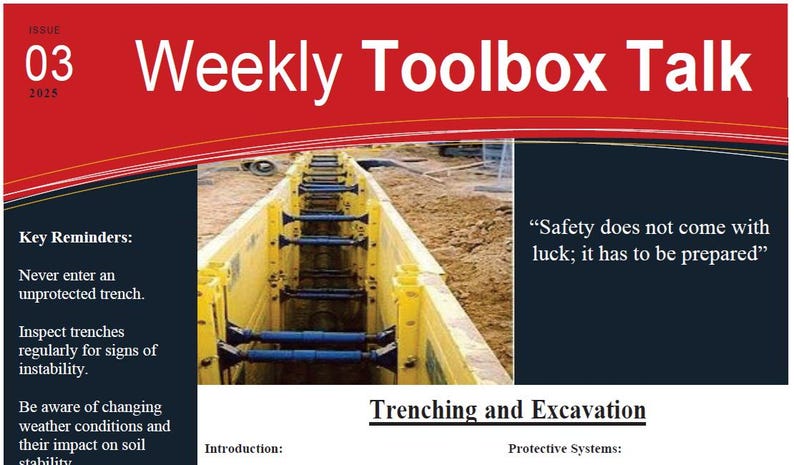
Common mistake: Workers reuse cracked safety glasses because “they still work.” They don’t. Cracks distort vision and compromise impact resistance.
2. Fall Protection Whether on scaffolding, roofs, or ladders, falls are a leading cause of injury. Discuss anchor points, harness fit, and edge awareness.
Pro tip: Demonstrate how to check D-rings and lanyards for wear before every use.
3. Ladder Safety Cover the 4:1 rule (for every 4 feet of height, the base should be 1 foot out), three-point contact, and maximum load.
Realistic hazard: Using a step ladder sideways to reach over equipment—a fast track to tipping.
4. Hand and Power Tool Safety Inspect cords, guards, and triggers. Never carry a tool by its cord. Always disconnect before changing blades or bits.
Use case: A grinder without a guard caused a flying shard injury on a Texas pipeline job. That site now starts every shift with a tool check.
5. Electrical Safety Focus on lockout/tagout (LOTO), avoiding wet conditions, and recognizing damaged cords. Remind teams that even low-voltage systems can kill.
Critical reminder: Never assume a circuit is dead—test it.
6. Confined Space Entry Review permits, gas testing, ventilation, and rescue plans. Stress that “just ducking in” to retrieve a tool is never safe.
Limitation: Many crews skip atmospheric checks because “it’s just a quick job.” That mindset kills.
7. Hazard Communication (HazCom) Discuss SDS access, labeling, and safe handling of chemicals. Workers must know what they’re exposed to and how to respond if exposed.
Workflow tip: Keep digital SDS on tablets or phones for quick access in the field.
8. Slips, Trips, and Falls (Same-Level) Often overlooked, same-level falls cause lost-time injuries. Address housekeeping, wet floors, and cluttered walkways.
Example: A warehouse reduced slip incidents by 40% just by assigning “zone cleanup” roles before shift start.
9. Fire Prevention and Emergency Response Review fire extinguisher types (PASS method), evacuation routes, and assembly points. Test knowledge with quick drills.
Checklist: Is every extinguisher visible, unblocked, and tagged?
10. Material Handling and Manual Lifting Teach proper lifting techniques: bend knees, keep back straight, lift with legs. Encourage team lifts for heavy loads.
Common error: Twisting while lifting—even with good form—dramatically increases spinal load.
11. Equipment Operation and Pedestrian Safety Define traffic routes, spotters for reversing vehicles, and communication signals. Use vests, horns, and mirrors.
Real-world issue: A forklift operator couldn’t see a worker retrieving a dropped bolt—resulting in a leg fracture. Now, “no-go zones” are marked and enforced.
12. Working in Extreme Temperatures Cover heat stress signs (dizziness, nausea) and cold stress (numbness, shivering). Mandate rest breaks, hydration, and layering.
Pro insight: Acclimatization takes 7–14 days. New hires or returning workers need gradual exposure.
13. Hot Work Safety (Welding, Cutting, Grinding) Address fire watch duties, fuel cylinder storage, and spark containment. Permit required? Always verify.
Misconception: “It’s just 10 minutes of welding.” Fires start after the work ends—fire watch lasts 30+ minutes post-job.

14. Noise and Hearing Protection Review noise exposure levels and proper fit of earplugs or muffs. Encourage regular hearing tests.
Hidden risk: Hearing loss is cumulative. Damage can occur before workers notice it.
15. Mental Health and Fatigue Awareness Physical safety gets attention. Mental wellness doesn’t. Talk about fatigue, stress, and the importance of speaking up.
Why it matters: A fatigued worker is as risky as an untrained one—slower reactions, impaired judgment.
How to Run a Toolbox Talk That Sticks
A great topic isn’t enough if the delivery falls flat. Here’s how to make talks effective:
- Keep it short. 10 minutes is ideal. Respect crew time.
- Pick the right moment. Before starting high-risk tasks, not at the end of a long shift.
- Use visuals. Bring a broken tool, a damaged harness, or a photo of an incident.
- Invite participation. Ask, “Has anyone seen this go wrong?” or “What would you do here?”
- Rotate facilitators. Let experienced workers lead. It builds ownership.
Avoid reading from a script. Speak naturally. Let the talk feel like a real conversation, not a lecture.
Workflow tip: Keep a sign-in sheet. Not just for OSHA—it shows workers their time and input are valued.
Common Mistakes That Undermine Toolbox Talks
Even well-intentioned talks fail when these errors occur:
- Repetition without variation. Talking about PPE every Monday loses impact. Rotate topics based on work.
- One-way delivery. If no one’s talking back, they’re not engaged.
- Ignoring near-misses. These are free lessons. Use them as talk topics.
- Skipping documentation. No record? It didn’t happen—legally and culturally.
- Generic topics. “General safety” is meaningless. Be specific: “Scaffold plank overhang limits” is better.
A construction crew in Ohio cut hand injuries in half by replacing “general PPE” talks with weekly deep dives—gloves for cutting, grinding, chemical handling, etc.
Integrating Toolbox Talks Into Daily Workflow
The most effective safety programs don’t treat toolbox talks as a standalone task. They’re woven into the job.
- Link talks to the work plan. If welding is scheduled, cover hot work safety that morning.
- Use them for changeovers. New crew? New equipment? New hazard? That’s talk time.
- Track topics monthly. Ensure coverage across key risks and avoid gaps.
- Review near-misses immediately. Turn incidents into teachable moments within 24 hours.
Digital tools help. Apps like SafetyCulture or iAuditor let you schedule talks, assign topics, and store records—no paper, no lost binders.
But tech doesn’t replace presence. The best talks happen face-to-face, on site, with boots on the ground.
Make Safety a Conversation, Not a Chore
Toolbox talks work when they’re respected, relevant, and real. They’re not about checking a box. They’re about protecting the people who show up every day to get the job done.
Use this list of toolbox talks as a living resource. Rotate topics. Invite participation. Learn from mistakes. Build a culture where safety isn’t enforced—it’s expected.
Start tomorrow’s shift with more than a status update. Start with a conversation that matters.
Frequently Asked Questions
What is the ideal length for a toolbox talk? Aim for 10 to 15 minutes. Long enough to cover the topic, short enough to hold attention.
Who should lead a toolbox talk? Supervisors, safety officers, or experienced team members. Rotate to promote engagement.
Do toolbox talks need to be documented? Yes. Record the topic, date, attendees, and facilitator for compliance and tracking.
Can toolbox talks be held remotely? For field teams, in-person is best. Remote talks work for desk-based or hybrid teams but lose impact without visuals.
How often should toolbox talks occur? At least weekly. Daily for high-risk operations or changing conditions.
Should employees be trained to give toolbox talks? Yes. Brief facilitator training ensures clarity, consistency, and safety message accuracy.
Are toolbox talks required by OSHA? Not explicitly, but OSHA expects regular safety training and communication. Toolbox talks fulfill that expectation.
FAQ
What should you look for in Essential Toolbox Talks for Safer Workplaces? Focus on relevance, practical value, and how well the solution matches real user intent.
Is Essential Toolbox Talks for Safer Workplaces suitable for beginners? That depends on the workflow, but a clear step-by-step approach usually makes it easier to start.
How do you compare options around Essential Toolbox Talks for Safer Workplaces? Compare features, trust signals, limitations, pricing, and ease of implementation.
What mistakes should you avoid? Avoid generic choices, weak validation, and decisions based only on marketing claims.
What is the next best step? Shortlist the most relevant options, validate them quickly, and refine from real-world results.

:max_bytes(150000):strip_icc():focal(728x275:730x277)/princess-catherine-prince-william-donald-trump-king-charles-iii-trump-state-visit-uk-windsor-091725-8672599a27214b6f8ffdbb07fd7596e4.jpg)